
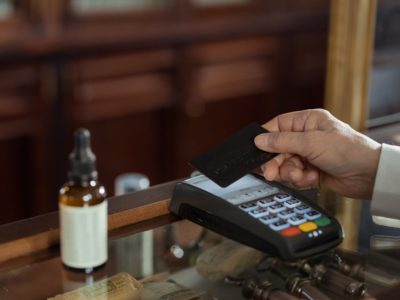
Mobile merchant services are growing at a breakneck pace. These days, paper money is used for only 19% of payments. Mobile merchant payments, on the other hand, nearly doubled in 2021 to reach $66 billion in value and accounted for 21% of all mobile money transactions.
Mobile merchant services are a popular form of payment processing as mobile payments take a fraction of the time as credit and debit cards. Customers simply hold up their iPhones and press a button to make payments. Mobile payments just require a card reader, so they can help eliminate long lines at small businesses’ POS stations. They’re great for pop-ups, fashion trucks, and any other SMB that can’t afford long line wait times.
As such, mobile merchant services are a great way for SMBs to create better checkout experiences. They aren’t just for in-store transactions at your point of sale; eCommerce stores can also benefit from letting customers pay with a single click.
What Is Mobile Credit Card Processing?
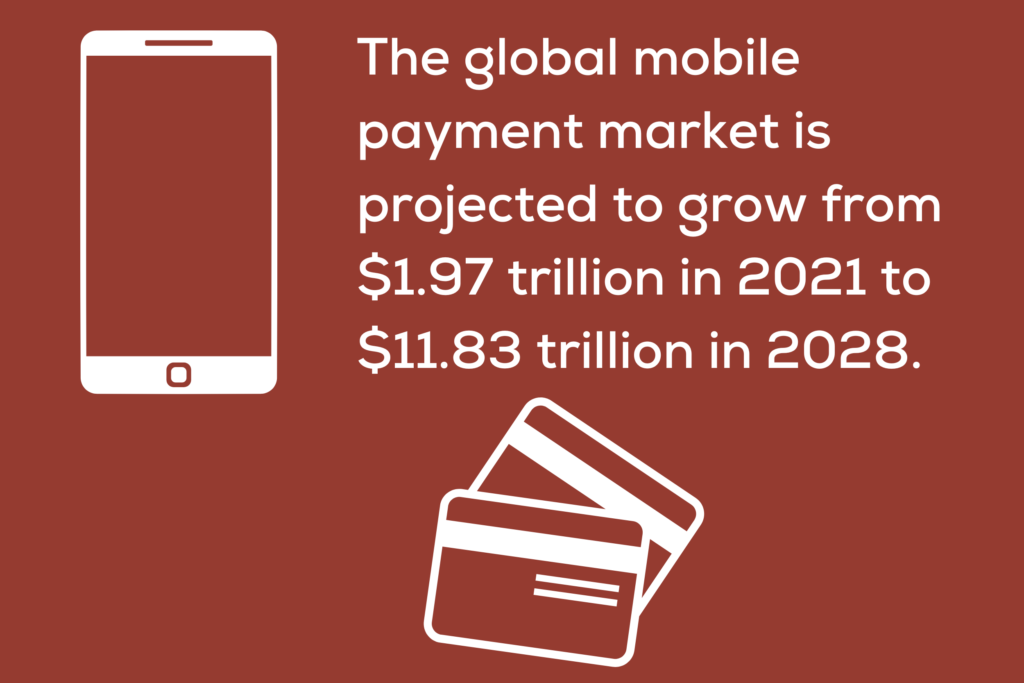
Mobile merchant services let businesses accept mobile payments, such as Apple Pay or Google Pay, on a mobile card reader. Customers just “tap” their mobile devices––Android phones, iPhones, iPads––at a retailer’s card reader, and voila, the payment is processed. The global mobile payment market is projected to grow from $1.97 trillion in 2021 to $11.83 trillion in 2028.
Large retailers love mobile payments because they can help reduce lines at their point of sale. Small business owners love mobile payments because they let them forego traditional POS systems. All SMBs need is a mobile credit card reader to process in-person payments. And almost any card reader can be turned into a mobile POS.
Mobile credit card processing is also called “contactless payments.” EMV chip card payments require customers to use physical credit or debit cards. Mobile payments, on the other hand, serve up the same functionality in a fraction of the time.
Mobile Payment Processing Terminology
As with most payment solutions, mobile payment processing has a dictionary worth of terminology. Let’s demystify some of the most commonly used terms.
Contactless payments
This term is often used interchangeably with “mobile payments.” Contactless payments use NFC technology, which we will define in a moment, to share payment data between devices. Most card readers are set up to accept contactless payments. Keep in mind that contactless payments are online payments. You’ll need internet and Bluetooth connectivity to process them.
Mobile card readers
Mobile card readers can be plugged into your phone to process customers’ credit card payments on the go. Any recent iPhone or Android device can be turned into a mobile card reader. Just download the mobile app to begin processing payments.
Mobile point of sale
Your mobile point of sale (mPOS) is your virtual terminal. Use it to process customers’ credit card payments––Visa, American Express, Mastercard, Discover––via Bluetooth. All you need is internet connectivity and an app, depending on your payment processor.
EMV chip cards
EMV chip cards are also called “chip and signature” cards. EMV forgoes the iOS device. Customers just insert their chip cards and sign at your POS station. They’re faster than magstripe transactions but slower than contactless payments. The plus side of EMV is that you don’t need Bluetooth connectivity to process transactions.
NFC
NFC, or near-field communication, is the technology that shares payment info between devices during contactless payments. Newer POS systems will have NFC built in. Older models may need additional hardware.
Magstripe
Magstripe payments are more of a traditional “swipe and sign” form of payment processing. Magstripe can be used with mobile card readers or a traditional point of sale system. However, many newer card readers no longer have magstripe capabilities, since it’s less secure than chip or contactless payments.
QR codes
QR codes are another payment option that lets you forego card transactions. This is particularly popular for small businesses that use PayPal or Venmo to process payments. Customers just use their mobile devices to scan a unique code. Then they verify the retailers’ information with their payment app to pay for goods or services.
What Are Mobile Merchant Services?
All of the payment types we just covered fall under the umbrella of “mobile merchant services.” Any payment that’s processed using a mobile device fits this description.
Benefits of Mobile Merchant Account Services
Tired of losing prospective customers at your online store or physical locations? Mobile merchant services are a cost-effective way to reduce wait times. The money goes right from your customer’s bank account to your merchant account, without the hassle of invoicing.
You can use your mobile card reader as a credit card processor or for contactless payments. It’s all considered mobile merchant services.
How to Choose a Mobile Merchant Services Provider
All mobile merchant services providers aren’t created equally. Here are some considerations to keep in mind when shopping for one.
Features
It’s not a “the more, the better” situation. You don’t want to pay for features you won’t use. If you won’t sell gift cards, for instance, why pay for processing capabilities? You’ll also want to take a look at how many business days it takes to process transactions, as well as any disclosures or fine print.
Payment options
Before you choose a payment processor, you’ll want to look at the payment options your customers use the most. Do they want to use contactless payments like Clover Go or Samsung Pay? Do you need a payment gateway for online payments?
Pricing and processing fees
This is a big one. Processing rates/transaction fees vary by payment service providers. So do monthly fees and chargeback fees. Find a breakdown of different payment processing pricing structures in this article.
Hardware
Ask yourself this: what hardware does your business need to maximize revenue and efficiency? You may need a POS station, a mobile card reader, Bluetooth capabilities, customer data tracking, etc.
Integrations
Your payment processing hardware doesn’t exist alone. You want it to easily integrate with your existing applications—QuickBooks, Shopify, etc., so you’ll have less busywork down the line.
Security
PCI compliance is the new gold standard, and merchants face fines if their businesses aren’t up to par. Many payment processors, such as Iron Rock Payments, manage PCI compliance for you. Others charge for this service. Double-check your contract to ensure PCI compliance is included, to avoid nasty surprises down the line.
4 Best Mobile Merchant Service Providers for Small Businesses
We’ve talked a lot about mobile merchant services, features, and what to look out for when considering payment processors. Now let’s look at some of the best-in-class mobile merchant services providers.
1. Iron Rock Payments
Iron Rock Payments offers in-demand mobile card readers and regardless of your transaction volumes, all you pay is a monthly fee for the direct costs of interchange. Plus, we’re PCI compliant with incredible customer support.
2. PayPal
PayPal is great for high-risk businesses that may not be able to get approved for traditional payment processing. PayPal now offers hardware through Zettle, but its aggregate processing still makes it less secure than competitors.
3. Shopify
Shopify has a flat rate pricing structure with a month-to-month contract. It’s perfect for SMBs that are just getting started and has a competitive mobile card reader. With that said, its new app only supports iOS devices. So, Android users will want to look elsewhere.
4. Square
Square is another processing solution with a great mobile card reader. It has an incredible suite of features and integrations. However, Square charges a per transaction fee which makes it pricey for processing small transactions.

 Do You Need A High Volume Merchant Processing Account?